by Dale Meredith | Jun 22, 2020 | Family Safety
Funky Town – Anyone old enough to remember this fun upbeat song from the 80’s. If not, google it and give it a good listen to. Pay attention to the words ‘Talk about it, Talk about it, Talk about it, Talk about, Talk about…
Are you talking about what you should with your kids? And yes, I’m referring to that crazy awesome thing called the internet, that we all use daily. A great place to find information, share stories, photos or catch up with old friends.
But what about all the dangers that come along with internet use? Especially for our kids. As adults, we can usually spot a scam and move on. But our kids just don’t have the knowledge or experience to understand what is happening online until it’s too late.
So, what do you do as a parent to keep your child safe on the internet?
First and foremost, talk to your kids. Have that dreaded conversation and get ready for the eye rolls and a little bit of attitude. Because it will happen. Trust me.
Explain to your kids, that while the internet is a wonderful tool, it can also be a dangerous place and you have to make good choices. Be honest.
We tell our kids not to talk to strangers at the grocery store, the mall or anytime they are out without us. Why should the internet be any different?
Build a little trust with your child. Remind them that if they come across something questionable, it’s ok to come to you with it. How many times have you searched for something and ended up on a sketchy website? It happens. Praise your kid for telling you.
You are the parent. Remember that you are the parent. It’s your job to keep your child safe. That means that it is OK to say no. No to the internet, no to a device and no to being on that device all hours of the night.
It’s OK to set limits. The coolest feature on most devices today is Parental Controls. Oh yes, this has to be one of the best features of these devices. You can literally shut down devices after a certain time, block inappropriate content and set age restrictions to certain sites. Do it.
Of course, this doesn’t replace having a conversation with your kid about internet safety. And it certainly won’t block all inappropriate sites, but it’s a good start.
Today’s kids have information at their fingertips, but it’s not always good information. The internet won’t tell your kids not to talk to strangers online. It certainly won’t tell them about scams, cyberbullying, or predators. That’s your job.
If you don’t talk to your kid about the potential dangers on the internet, how do they know these even exist? Think about that for a minute.
So, TALK ABOUT IT! TALK ABOUT IT! TALK ABOUT IT!
Talk to your kids. And if they don’t listen, you have parental controls on your side. Use them 🙂
by Dale Meredith | Jun 17, 2020 | Family Safety
Remember the days when the schoolyard punk would come up to you or someone you knew and threaten them until they gave up their lunch money? Well, those days aren't over. And back in my day, we got to go home at the end of the day to get away from the mean kids.
In today's world, bullying doesn't stop there. Cyberbullying refers to the threatening or harassment of another via digital media. With the rise of social media, kids can be tormented endlessly by other children, even at home. Many kids are afraid to come forward about it, mainly because they find it embarrassing. Instead of hearing a comment at school and ignoring it, they have it written in a text message or email that can be read over and over again.
The psychological trauma of bullying is real. Anxiety, fear, self-esteem issues, and depression all stem from this negative treatment. With cyberbullying, there is no relief from it. Teachers, neighbors, friends, and family may not overhear what's going on because your child is receiving threatening messages over a digital medium instead of by word of mouth. Many schools have vague rules regarding cyberbullying if any at all.
Educating your kids about cyberbullying and the harm it causes is the best way to prevent it. Ensure they understand that it's ok to come forward if they are being bullied. Enforce strict punishment if they are found bullying others. If you or a loved one are a victim of cyberbullying, speak up, and inform the proper authorities.
For continued advice and learnings on how to help your family stay safe and smart with the technology you use, follow
Dale Dumbs IT Down on Instagram
Dale Dumbs IT Down on Youtube
Learn more about the why behind my journey of helping families stay safe and smart with the technology they use at https://www.daledumbsitdown.com/
by Dale Meredith | Feb 27, 2020 | Family Safety
I see too many friends of all ages hitting gameplay hard. My worry for these friends and family members and their video game addiction has led me on a quest to learn more about gaming addiction. Here's a bit about what I've learned.
Video game addiction is a real mental health condition affecting millions of people around the world.
The World Health Organization added 'gaming disorder' to the 2018 version of its medical reference book, International Classification of Disease. But the American Psychiatry Associations manual still only lists gambling as the only 'activity' that is addictive.
Worldwide research reflects that video game addiction is a problem for people of all ages. Support groups are helping children as young as 8 years old and adults as old as 65 years old with gaming disorders.
Here are a few signs you can look for in yourself or someone close to you to better determine addictive behaviors.
· Do you find yourself thinking of gaming all or a lot of the time
· Do you feel bad, sad or left out when you can't play.
· You feel more time spent gaming will help you feel better.
· Setting goals to play less or quit a specific game but unable to accomplish that goal.
· Not wanting to do other hobbies or activities that you used to enjoy.
· The amount of time you are playing is causing problems at home, school or your work.
· Do you lye to people close to you about the amount of time you are really playing.
· Using game playing as a way to calm your moods or manage your emotions.
Video Game addiction is a compulsive mental health disorder that can cause severe damage to one's life. It's common for a video game addict to spend over 10 hours a day gaming, usually well into the night, and many suffer from sleep deprivation.
Many experts agree that not everyone who plays a lot has a problem with gaming and they warn us to be careful about labeling people who might just be enthusiastic about gaming as an addict. The impact of gaming addiction varies based on the research study but it falls somewhere between 3% to 9% of all gamers, adults and kids alike. Research does agree that gaming addiction is more common in boys and men than in girls and women.
For continued advice and learnings on how to help your family stay safe and smart with the technology you use, follow
Dale Dumbs IT Down on Instagram
Dale Dumbs IT Down on Youtube
Learn more about the why behind my journey of helping families stay safe and smart with the technology they use at https://www.daledumbsitdown.com/
Photo by SCREEN POST
by Dale Meredith | Feb 25, 2020 | Family Safety
I know you "don't get it." I barely get it, but I've been on a mission to learn why this particular game, Fortnite is so addicting for our kids.
Fortnite is similar to the ultra-popular Minecraft game, in that building and creating is part of the focus of the game. Within Fortnite, players can build forts with materials they find. They may also be able to loot supplies and equipment from defeated players, find random supply drops, and discover chests that contain weapons, tools, and supplies. These types of "rewards" hold a strong appeal for kids.
The excitement of finding a chest and the possibility of what could be inside is one such tactic that reinforces a person's desire to continue playing and to continue to receive rewards. Another tactic that makes Fortnite appealing is the near-miss. When your character is killed on Fortnite, you get to see the health bar of the person who killed you. Often you will see that your opponent was also close to dying, so the game feels like it was very close. The near-misses are stimulating, and you feel compelled to keep playing.
On top of all this adrenaline already in the game, there's the social component. Players can play with friends. And we all know how important friends are and if playing a game is fun by yourself then obviously it's going to be more fun if you're playing with friends. The emotional connection to friends during the gameplay can create potential conflicts with kids and their parents as parents enforce boundaries for screen time and gameplay. If you've set a time to play with a friend, you're going to want to keep that appointment. If your friend wants to play the next game, your child won't want to let him down. If you're not on when your friends are playing, you might feel you are missing out. And for kids, as with many adults, the feeling of being left out is one of the worst feelings there is.
So how much Fortnite is too much? A recent study shows that moderate gameplay (ranging from 7 to 10h a week) has been linked to higher emotional stability, reduced stress levels, increased social interactions, increased life satisfaction, and an enhanced sense of achievement, as well as greater psychological resilience in general. That's pretty great. Gaming isn't all bad!
But, let me repeat that, 7 to 10 hours a week shows positive outcomes. That's about an hour a day of gaming.
Studies also show that too much gameplay has been linked to aggressive behavior, dysfunctional coping strategies, decreased academic achievement, as well as sacrificing physical activity, sleep, and school responsibilities.
Weird, I don't remember Pac Man or Donkey Kong, making me overly anxious, but the dynamics of today's gaming is off the charts compared to the games I played in old-school arcades.
Balance and moderation certainly seem to be the key when setting boundaries for gameplay.
For continued advice and learnings on how to help your family stay safe and smart with the technology you use, follow
Dale Dumbs IT Down on Instagram: https://www.instagram.com/daledumbsitdown/
Dale Dumbs IT Down on Youtube: https://www.youtube.com/daledumbsitdown
Learn more about the why behind my journey of helping families stay safe and smart with the technology they use at https://www.daledumbsitdown.com/
Photo: Alex Haney
by Dale Meredith | Feb 24, 2020 | Family Safety
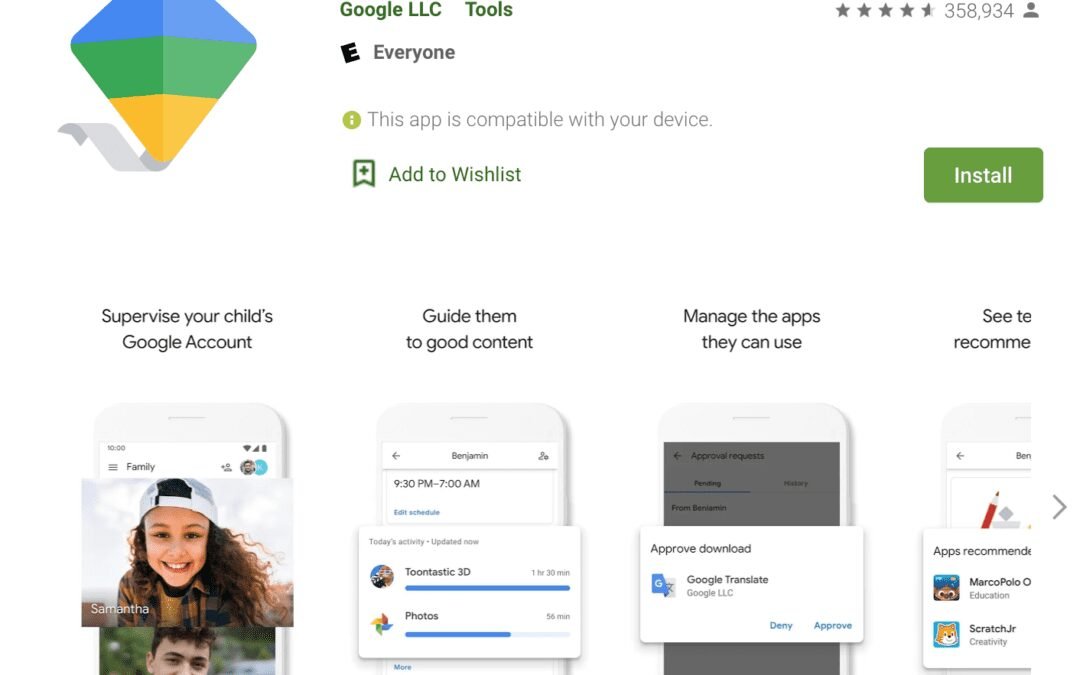
I get a lot of folks asking what app do I use to help protect Gabe on our family phone (for when he uses it). Well, last year, Google released a free app called "Family Link" for both Android and iOS.
This app allows parents to manage the content on their kid's devices including Chromebooks. You can be notified (and either approve or deny) apps that your kids are trying to download, find out what apps they're spending most of their time on, limit the amount of screen time each day or a new feature this month, the ability to set time limits per app! I know, right?! You can lock devices for bedtime, direct your kids to "YouTube Kids' instead of standard YouTube, and if your child needs more time added, you can easily add it from the parent's phone. Plus, you can view the device's location on the map and ring it if need be. Other features include a restricted Chrome experience (help block adult websites) and stop them from using incognito mode (a mode used to high your tracks). Now some features aren't available on the iOS side, but Google is always striving to make their products better.
Please note that because of privacy laws, you can't stop any child's account over the age of 13 (depending on your country's minimum age for having a Google account) from turning off these parental restrictions. But that doesn't stop me from using another app to block access to Family Link (yeah, I'm smarter than the average bear), which I'll cover tomorrow. Family Link isn't a total solution, but it's definitely a great option.
Also, don't forget to check out your very own internet service provider as most offer free parental controls for users to make the internet a safer place for their younger family members. While there are several other parental control software options available for sale, find out what free options your ISP offers or check out "Family Link"
For continued advice and learnings on how to help your family stay safe and smart with the technology you use, follow
Dale Dumbs IT Down on Instagram: https://www.instagram.com/daledumbsitdown/
Dale Dumbs IT Down on Youtube: https://www.youtube.com/daledumbsitdown
Learn more about the why behind my journey of helping families stay safe and smart with the technology they use at https://www.daledumbsitdown.com/
by Dale Meredith | Feb 23, 2020 | Family Safety
My first "What the crap is this on my son's phone" moment was over 14 years ago. This amazing son pictured here with me was barely 14 years old and thought he was all the rage with his Razor flip phone. When locking up the house one night I walked into his room to turn out his light. He was fast asleep and his phone was charging on his window sill with a blinking light showing he had an incoming text message. I flipped open his phone and there it was, a picture of a naked teen staring back at me. The text read 'Hey, you don't know me but I sit in the back row of your English class, do you want to hook up?'. Yes, that moment in time was a game-changer for me as a dad.
Sexting is not going out of style, though many have become numb to it over the years. Sexting is increasing in popularity among teens. A recent study shows that 20% of 13 to 17 year old's openly admitted they have used their phones for sexting and 39% admitted to forwarding an inappropriate picture they had received. Come on, we all know teenagers, if that many admit openly how many are really involved, the number could be staggering.
The point is… parents talk to your kids, not only to keep them safe from this content but because teen sexting is a federal crime in the U.S. Anyone who sends or receives a nude photo of a child could be charged with distribution of child pornography. Convicted teens may even have to be registered as a sex offender.
For continued advice and learnings on how to help your family stay safe and smart with the technology you use, follow
Dale Dumbs IT Down on Instagram: https://www.instagram.com/daledumbsitdown/
Dale Dumbs IT Down on Youtube: https://www.youtube.com/daledumbsitdown
Learn more about the why behind my journey of helping families stay safe and smart with the technology they use at https://www.daledumbsitdown.com/