Electronics rule. Phones and technology are everywhere. Smartphone apps dominate everything. Let’s face it, it’s getting harder to live without technology. Recharging powered devices is not possible everywhere. I love to camp. Love to be outdoors. And I love to work remotely off the grid so having an additional power supply for my devices matters.
A very viable and affordable option is portable power stations. Essentially, it’s like a power bank. Pocket-sized power banks typically use USB power and they’re great for powering your phone for about 5-6 charges, but when you’re away for a handful of days (or even a week), the pocket-size battery banks just don’t cut it. Power stations go beyond USB power. One I’ve had my eye on is the Jackery Portable Power Station Explorer 240. There’s a lot to love about this power station. Let’s take a look at what this power station offers in the review below.
Jackery The Brand
I’ve heard nothing but good things from customers and users of Jackery’s portable power stations. In fact, that’s what originally drew me to their brand in the first place. Yes, I trust reviews. Yes, I love to read about what critics have to say. BUT…word of mouth promotion from people I know and trust matters a lot more. Aside from what friends and family have had to say about I’ve done some digging and Jackery has quite the reputation. In terms of longevity, they’ve only been around for about a decade, but they are one of the early pioneers of portable solar-generated power. That stands for something. They’ve been doing this for a long time in regard to the industry. Their products have also been featured on Forbes, Digital Trends, Tom’s Guide, CNet, and a handful of other reputable publishers so having that endorsement is a good indicator of the quality of their products.
When you couple word-of-mouth endorsements and other reputable source’s endorsements with a solid warranty (2-year limited warranty on products) plus great service, Jackery is a brand that stands behind its products.
Jackery Explorer 240 Model Design
The Jackery Explorer 240 is roughly rectangular. It’s not so tall, but because of its handle, it kind of feels that way. Durable plastic adorns the exterior of the handle with grooves to provide a better grip. It is primarily black with orange highlights and bears a bold “Jackery” imprint. I dig the colors. Love the design elements of this. When you first pick it up, it just feels like a quality-built product.
Jackery Explorer 240- Power and Performance
Power stations heavily rely on their batteries. A 240Wh battery powers the Jackery Explorer 240. Some of the more popular uses and devices that people use in the Jackery 240 are smartphones, tablets, laptops, lamps, cameras, drones, and tire inflators.
Now…you won’t be able to charge a blender, electric grill, small fridge, or microwave with this model, BUT Jackery has some upgraded models that will give you that kind of power (more on that below). What I really love about the performance of this model is it’s quiet, clean, easy to use, and relatively safe.
Jackery Explorer 240 Safety and Compliance
Jackery Explorer 240 has four charging ports. A pure sinewave AC outlet. The sine wave has smooth waves, not sharp peaks. Therefore, sensitive electronics are safe. There is a maximum current limit of 200 watts. This will lead to the inability to operate heating devices, which will consume 400 watts for a short time. If you want more power, then get the upgrade. There is no automatic shutdown of small coolers when the input is active either. 12-volt DC is standard in cars, and the USB ports deliver 2.4 amps and 12 watts.
The Explorer 240 has power-saving circuitry. The power station shuts down if not fed with 10 watts for 12 hours. Definitely a nice safety feature. This function reduces battery drain.
Built-in MPPT. MPPT controllers increase battery current by 30%. A solar panel can quickly recharge the Explorer 240 (you’ll need to purchase this separately)
Sine wave inverter. A pure sine wave inverter produces similar AV power. Inverters that modify sine waves cannot charge sensitive electronics.
Smart display. Its backlit display is right in the middle so that nobody will miss it. Input power, remaining battery, and output power appear on the screen.
On/off switches. A power station generally has a single on/off switch for all outputs. All three outputs of the Explorer 240 have separate on/off switches.
Pass-through charging. Pass-through charging lets you charge your devices while the Explorer 240 charges.
Specs
Brand: Jackery
Wattage: 200 watts
Frequency: 60 Hz
Power Source: AC, CarPort, Solar Panel
Item Weight: 6.83 lbs
Voltage: 110 Volts (AC)
Output Wattage: 200 Watts
Color: Black
Material: Lithium
Pros
AC sine wave.
An ultracompact design
Noiseless.
Cons
Not suitable for CPAP (although it will work with it)
You will not be able to carry on this item due to travel restrictions with lithium batteries and due to FAA restrictions, no more than 100-watt hours capacity is allowed with checked baggage.
The battery is not replaceable
The USB Type-A ports don’t support quick charging.
Let’s Talk Jackery Upgrades
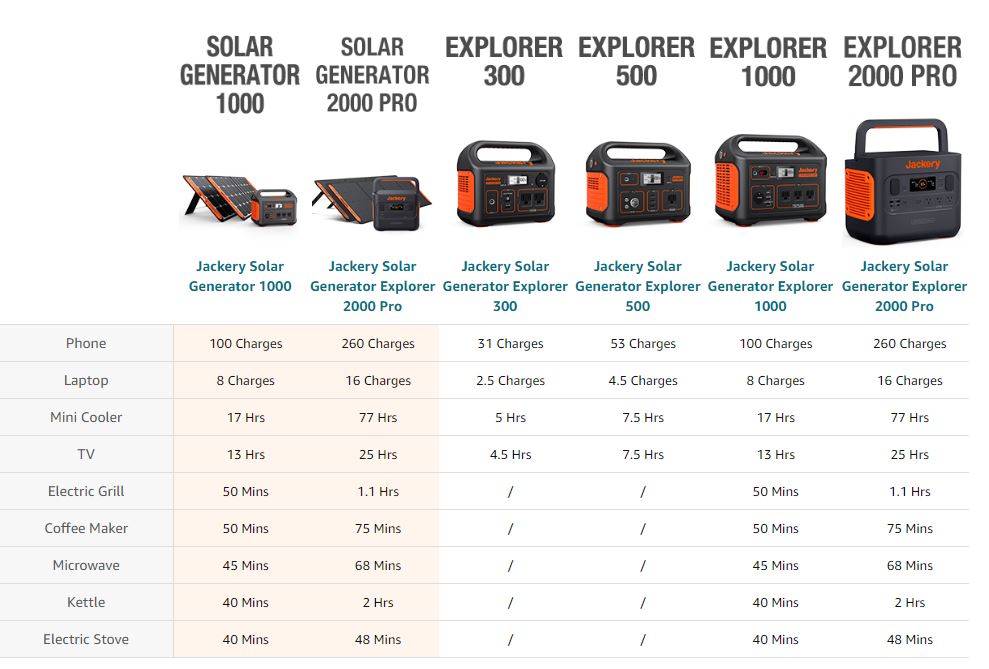
There are two reasons why you’d want to get an upgrade: you want the Solar Generator unit or you want more power. Below you can see the extra charges broken down by device type. One advantage of getting a solar generator model is the ability to charge appliances like an electric grill, coffee maker, and microwave. You will not be able to do that with the 240, 300, or 500 models. In my opinion, if I were to opt-in for an upgrade it would be the Jackery Solar Generator 1000. It’ll cost you around $1700, but right now on Amazon, you can get an extra $250 dollars off when you apply the coupon. Now, if that is a too high of a price tag and you really like the 240 models BUT really want the solar option, this Jackery Solar Generator model is what you’ll want.
Image Credit: Amazon.com:
Jackery Portable Power Station 240 User Reviews
This product has an amazing 4.7 rating out of 5 on Amazon. What makes that even more impressive is that the rating is carried across 16K+ reviews. Based on customer ratings by feature, noise level (5.0), portability (4.8), value for money (4.8), lightweight (4.7), and charging power (4.6) are the most important features customers love about the Jackery 240 portable power station. Those ratings are slightly better than Anker’s with each feature rating respectively.
There’s a lot to love about the Jackery Explorer 240. Despite its lightweight, it provides USB, AC, and DC power. With its LCD, it’s easy to use. For entry-level portable power stations, you’re not going to find a better option for portability mixed with power.
We all have a love/hate relationship with our cell phones. Not only do they provide entertainment besides communication abilities, but they also open users up to various scammers and hackers. Interestingly enough, we all have strong opinions about Androids or iPhones and which is best. Regardless of which operating system you prefer, it’s important to block any spam content on your devices. Previously, we discussed How To Block Scams, Spams, and Phishing Easily On Your iPhone. Like iOS systems, you can also block spam content on your Android.
Spamming 101
To put it simply, spam is anything users didn’t subscribe to or didn’t authorize on their phones, emails, texts, calls, etc. Spam can come in various forms from phone calls, text messages, emails and internal linking, and more. The most frustrating thing for users is redundancy. If you end up on a political spam list, you bet you’ll be on every political spam list in your area.
Let’s Talk About Spam Calls
If you own a phone, you’re probably getting spam calls at all hours of every day. We’re often unsure how we end up on these call lists, and just about everyone hates answering the call just to tell whomever to put them on the Do Not Call List. Whatever happened to that list anyways? The good news, you can still register your phone numbers and most spammers should cease calls within 31 days of registering.
Nowadays, it seems like you might recognize a number because it has the same or similar area code as your phone or a friend’s phone. That being said, how are these robocalls and spammers able to do that? These companies are taking a service that runs their numbers through multiple agencies, to lower their cost, and increase answers. Each time you answer a call, it proves that your number is legit, therefore increasing the stats on your number and gaining more spam calls. Instead of answering, just register on the Do Not Call List.
We all know the drill. You buy something in a store, they ask you if you want to join their rewards program. Not only will it save you money off initially, but forever X-amount you spend, you gain more money off later. For many people, that sounds like an excellent idea, but that one little rewards program has the potential to set your number up for unlimited spam messages. If the actual messages aren’t annoying enough, many spam texters add clickable links ready to infect your phone with malware and viruses. Though scamming and spamming seem never-ending, there are ways to block spam content for good.
Luckily, app creators are focusing on creating software to help smartphone users to stop spam content. For Android users, we highly recommend Bitdefender, as it’s the most reliable antivirus for Android systems. It provides users optimal protection against malware and data-theft activities. It offers the Scam Alert, which allows users to see warnings on suspicious messages and notifications. It has many features that can help block spam and scammers from stealing your information and sensitive data.
RoboKiller is another spam blocking app to make sure you can remove the annoyance of all the spam calls, messages, and content. Google Play shows an average rating of 4.1 stars for Android users, but an impressive number of over 5 million downloads. Despite many decent ratings, users are complaining about voicemail playback features and other bugs that RoboKiller needs to address.
Cellphone companies are also taking a step toward happier phone users through their spam-blocking apps. Verizon provides an optional upgrade for its users called Verizon Call Filter or Call Filter Plus. It provides spam detection and filtering with a visual rating per incoming call. You can see on a meter where the phone number ranks from low spam to high spam risk. Depending on your plan, you can get added features for an additional $2.99 per month for one line or $7.99 per month for three or more lines. T-Moble/Sprint also offers Scam Protection with similar screening options that let its user see a caller ranking of potential fraud.
No matter what, you need to take all technology seriously when you’re deciding to share your sensitive information. Whether it’s your Android, iOS system, or computer, you need to be aware and conscious of the content you’re sending and receiving. Common sense tells us not to open messages and links from people, numbers, and emails we don’t recognize. There are other ways to ensure you’re safe from spam content and hackers when in doubt. Take a look at some of our previous suggestions on keeping you and your family safe.
In my opinion, one of the most important things you own and use is your credit card. Many people are clueless as to how easy it is for hackers to get your information and make fraudulent charges. It’s no surprise that fraudsters target credit cards more than any other type of payment. And most of these criminals are very clever. Don’t worry though, there are plenty of little hacks and tools you can use to prevent credit card fraud from ever happening to you. Nothing is full-proof. There is no bulletproof method because the nefarious game of credit card hacking seems like it will never end. And it feels like it’s always evolving and innovating. With that said, check out our list of the best tools and hacks to help keep your cards safe.
Credit card companies often include many free features and tools to help deal with rampant card and identity theft. It is a high priority for them because if the public loses trust in credit card safety, these companies will have a massive problem on their hands. But these tools range from the ability to lock your card from purchases, thorough monitoring of the dark web, and a slew of other cool things. Aside from what they offer, there are some other hacks you can do that will give you an added level of security when making purchases with your card. Your challenge is to just try one of these this week. Make it a priority to take control of security in this digital world.
Use Your Credit Card Company’s App
This is a no-brainer. And I’m still shocked when I find people who don’t use an app to help manage their credit cards. Yes, you can still go online. Yes, you can still wait for that paper statement to arrive in the mail where you can send a check in each month to pay off your credit card statement. But for real…use your credit card company’s app! Credit card apps can help you track your spending. You can see exactly where you are spending your money and how much you are spending each month. This information can be really helpful in budgeting and making sure you are not overspending. Furthermore, you can get immediate notifications sent to your phone on every transaction.
Credit card apps can also help you stay on top of your payments. You can set up reminders for when your bill is due and track your payment history. This can help you avoid late fees and keep your credit score high. Credit card apps can help you get rewards for using your credit card. Many credit cards offer rewards points for every purchase you make. These points can be redeemed for cash back, gift cards, or merchandise. A lot of times, you must have the app to unlock those rewards (or at least redeem them).
Biometrics, Digital Wallets, And Contactless Card
Use biometrics whenever you can. This will most likely require you to use payments through Apple Pay, Google Pay, or Samsung Pay through your smartphone. I almost always use biometrics to pay versus a normal credit card. Biometrics are simply measurements of physical or behavioral characteristics. They can be used to identify individuals and verify their identity. The most common biometrics include fingerprints, iris scans, and facial recognition. Biometrics are becoming increasingly popular as a way to authenticate users (and not just with buying things either), especially in the realm of digital security. That’s because biometrics are unique to each individual and they’re very difficult to fake. Because of this, biometrics offer one of the highest levels of security when buying goods.
Contactless cards are another great feature to help reduce credit card fraud. They can be identified by a logo that looks like the Wi-Fi symbol of radiating waves. It leverages technology where you don’t have to put the card in a POS system.
Card Lock
If your credit card company has this service, enable it right now. Card lock or card freeze lets you essentially “turn off” your credit card to foil would-be thieves, which is particularly helpful if you lose it. Most of the time, you can use the mobile app to activate an On/Off switch for this feature.
We’ve already written a post on why you need to enable notifications on all your credit card transactions. This little tips can prevent a lot of loss IF your credit card does get hacked. Time is of the essence with hackers. If you can identify fraud quickly, you can seriously save your bacon when involved with fraud. Alerts allow you to also stay in the know on what’s happening with your account or any other security news and updates.
Never Store Credit Card Info On Your Phone
Let me explain. Sometimes I’ve seen people take pictures of their credit cards or write down their number with a CVC code in a Notes app on their phone. Big no-no. Just don’t do it. Now…if you wanted to use an app or service like LastPass Password Manager and leverage their secure notes feature…that’s not a bad idea. It’s much safer than just valuable personal information on your phone where it’s not password protected or encrypted.
This is another no-brainer, but I’ll take this a step further. Don’t ever put your personal information on any form on one of these sites. In fact, I’ll take this even one step further. Don’t even visit sites that aren’t secure. How do you know if a site is secure or not? If you look in the top left of the address bar right before the web URL on almost all browsers, you’ll see a little lock symbol. If you don’t, the site isn’t secure.
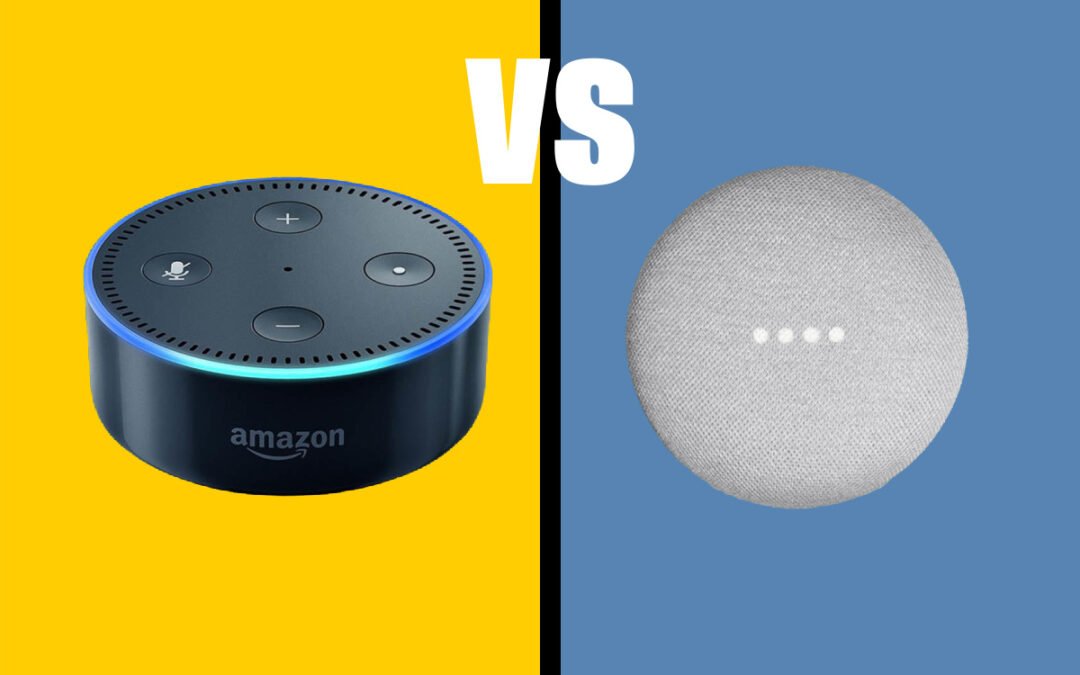
Are you going to buy a speaker or a smart home automation assistant but finding it difficult to choose between Google Nest Mini and the Amazon Echo Dot? Do you want a voice-activated assistant to help you with your day-to-day tasks? You’re probably wondering if the Google Nest Mini or Amazon Echo Dot is the right device for you and your family. We break down the most important features as we compare these two devices and help you decide which one is best for your needs.
The Features That Matter For Your Smart Home Assistant
Both the Google Mini and Amazon Echo Dot are great devices for families. Not going to lie, we have both in my home. That’s how good both of these are. But which one is better? Let’s compare the features that matter most between these two devices to help you decide which one might be best. We analyzed feature sets like design, utility, sound, technology, and ease of use to help you make the best decision possible.
Both of these speakers have slightly different sizes. There are LED lights present in both of them. I do think that the Amazon Echo Dot utilizes their LED lights more efficiently than the Google Mini. Seeing my Amazon Echo Dot with an orange-yellow light for notifications is something I’ve grown accustomed to.
The new version of the Echo Dot has a spherical shape and assists in making it look bigger compared to its counterpart. Furthermore, the Google Nest Mini doesn’t contain a clock option, but still, it utilizes LED dots for communication. It is also worth mentioning that it is available in charcoal, chalk, and sky. To me, colors don’t matter that much because the color doesn’t necessarily add any extra value (at least not significantly), but it’s a design feature worth mentioning.
One thing I want to point out: the build quality is remarkable in the Google Nest Mini as well. I love the compact design of both of these because you can integrate them into your home with one of these wall mounts for the Google Nest Mini or the Amazon Echo Dot. You can easily place them around the house without sacrificing your home décor or just getting in the way (note that you need a plug to use one of these home assistant mounts). And the ultra-compact design (and price for that matter) allows you to create an easy-to-use plus cheap smart home intercom system.
Amazon Echo Dot has a powerful smart home ecosystem. Compared to the Google Nest Mini, it’s a little better because of some cool utility options. Alexa has got a lot of amazing smart features that include things like skill blueprints as well as the whisper mode.
Moreover, Alexa has learned a lot of new stuff and keeps learning daily. I’m impressed at how Amazon strives to make the smart home experience better. It should also be noted that the routines and the reminders of Alexa are much improved than when the technology was first launched. But I want to return to a feature I just mentioned: I love Alexa Skills. Essentially, these are enhancements where you can really amp up the performance and utility of your device. Google does have skills and commands for their home assistant devices, but they just don’t compare in utility and efficacy vs Amazon’s Alexa. In this regard, the Amazon Echo dot is a better option when it comes to connectivity and utility.
Sound matters. Whereas most people aren’t going to use one of these for blasting music, sound quality and the technology behind it are still important for these small home assistants. If you’re looking for a quality small speaker system, the Amazon Echo Dot is the better option. The Echo Dot has a noticeable advantage with sound quality compared to the Google Nest Mini and it’s also more affordable. The Echo Dot uses a combination of Dolby processing and seven microphones to deliver clear, loud, and nuanced sounds. The Google Mini, on the other hand, only has two microphones and doesn’t use any Dolby processing. As a result, the Mini just can’t match the Echo Dot’s sound quality.
In addition, the Echo Dot has a more robust speaker system than the Mini. The Dot has a 2.5-inch woofer and a 0.6-inch tweeter, while the Mini only has a single 1.57-inch full-range driver. The Echo Dot’s superior speaker system ensures that you’ll have great sound quality, no matter what you’re listening to. And it’s not just about music either. I rely on my mini smart home speaker to deliver news, updates, reminders, and a slew of other notifications.
Winner: Amazon Echo Dot
Ease of Use
One of the main reasons why the Echo Dot and Google Nest Mini are so popular is because they are very easy to use. Both devices have a simple design. Both have impeccable technology that lends itself to making these devices simple.
Google Nest Mini and the Amazon Echo Dot devices both do a decent job of catching voice commands. Occasionally, if there is slight noise interference, you’ll run into issues, but generally speaking, both are adequate at picking up voice commands. In my opinion, if there’s a difference, the Mini’s voice recognition technology isn’t as accurate as the Echo Dot’s, which can sometimes lead to frustration when trying to give commands. I think that’s due largely in part because the Echo Dot having more microphones AND Amazon’s sound engineers are some of the best in the world. By a slight margin, I’d give the edge to the Echo Dot for those looking for a simple, easy-to-use voice assistant.
In terms of smart home integration and syncing these home assistants with another internet of thing devices, both do a phenomenal job. Most smart devices integrate with both Google Assistant and Alexa, so I don’t think either one of these home assistants has an advantage there.
Winner: Narrow Win For Amazon Echo Dot
It Really Comes Down To You
The best option really comes down to you. Before investing in one of these smart home assistants, it is essential to know all the specs and features so you won’t end up buying a useless thing. One of my pet peeves is seeing or hearing of people not using a smart device simply because they “don’t know how” or “it doesn’t work with what we have”. Even more important and on that note, take an inventory of all your smart home devices and get the home assistant that will fit your technology needs. Get one that will augment your smart home ecosystem. If you have devices that mesh better with Alexa, get the Amazon Echo Dot. If you like Google or you have more smart devices that fit with Google Assistant, go that route.
For the record, I don’t think there’s anything wrong with having a Google-based ecosystem AND an Alexa-based ecosystem either. There are some in my family who love certain things about the Amazon Echo Dot and there are some who like Google Assistant devices better. It doesn’t have to be an either-or situation. In fact, I have both in my home, which does lead to some confusion on my part.
In this modern age of technology, staying online while traveling is a must for many people. A stable connection while traveling is essential as you might want to check emails, upload media, get directions, check-into hotels, or access sensitive information. Travel routers can help save you money and time while providing a secure and stable internet connection.
Travel routers can easily connect and manage electronic devices while using public Wi-Fi. They can be helpful in various situations: hotels, conference centers, airport lounges, and other places where connections are restricted to limited devices.
How Do Travel Routers Work?
When choosing the best travel router for yourself, it is essential to understand how these routers work. Knowing a travel router’s specifications, security options, bandwidths, etc., will help make that decision easy.
Travel routers work as private hotspots for the available internet connection and create a Wi-Fi network bubble. They provide an internet connection to all the electronic devices you want from a single connection. Good routers are compatible with the latest Wi-Fi standard and provide advanced security encryption. Essentially, a travel router is expected to do the following:
Extend the range of wireless networks which have poor signals
Detects and amplifies weak signals
Create a wireless network to secure the connection
Incorporate a firewall to protect from DDoS threats
When the time comes to buy a new travel router, you should give several important characteristics careful thought. According to Forbes, you’ll need to locate a router that satisfies your speed, frequency, and security requirements, which are the most critical factors to look out for in a travel router.
Speed And Frequency
When choosing a travel router, the speed and frequency of the network that it can support is a significant factor. Another factor is network frequency; a dual-band router transmits both a 2.4 GHz and a 5 GHz signal instead of a single-band router that only generates a 2.4 GHz signal. Double-band routers allow for a faster network, increased range, and more device connections overall.
Security and Protection
Security is a significant concern when using public connections. Travel routers can help eliminate this concern. We suggest choosing a travel router with minimum WPA2 encryption and VPN capabilities.
When choosing a travel router, many choices are available in the market, each offering a diverse range of functionality and benefits. Following are what I would consider being the best choices when it comes to travel routers. Although these routers are great for travel, I personally travel with my Firewalla Purple. It’s a fantastic travel companion for technology. It’s compact, easy to travel with, has built-in Wi-Fi (so I get that protection on the go), and I can still monitor all of my devices with parental controls.
Among travel routers, TP-Link’s AC750 (TL-WR902AC) is one of the fastest travel routers available in the market. It is portable and cost-effective and has a low price of only $39.99. Its small size makes it portable enough to carry around in your pocket.
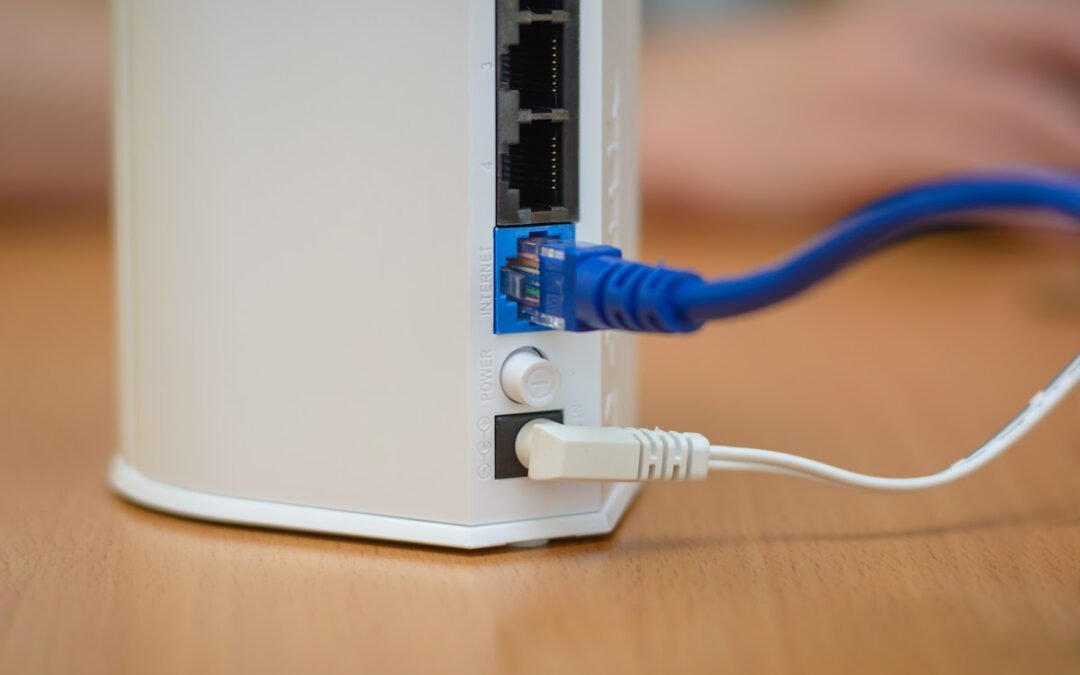
It offers dual-band Wi-Fi performance and can be used as a bridge to link a wired device to a wireless network by utilizing its built-in Ethernet connector. It can also work as a range extender, a private Wi-Fi hotspot, or even a router to build a wireless network.
This product has a 4-star rating out of 5 on Amazon. More than 15.5K reviews are what generate this rating. Based on customer ratings by feature, ease of use (4.3), versatility (4.2), and easy to install (4.0) are the most important features customers love about the TP-Link AC750. Those ratings are slightly better than Anker’s with each feature rating respectively.
GL.iNet GL-MT300N-V2 (Mango) Portable Mini Travel VPN Router
The GL.iNet GL-MT300N-V2 is one of the more affordable travel routers. Though its functionality makes it a router more suited for beginners hoping to try out the technology, it still boasts many features that are a must in a travel router.
You get two 100 Mbps Ethernet ports for sharing a wired network, 2.4 GHz Wi-Fi support, and support for WPA2 and WPA3. Additionally, privacy is a big focus as it has VPN capabilities and built-in support for Cloudflare’s DNS over TLS.
Another fantastic feature is connecting a smartphone with tethering capabilities using the router’s USB 2 port.
Some of its features are:
Tethering
Dual Ethernet ports
OpenVPN client pre-installed
Small and super light
Enhanced security protocols and data encryption
Speeds up to 300Mbps
GL.iNet GL-MT300N-V2 User Reviews
This product has a 4.2 rating out of 5 on Amazon. More than 8.9K reviews are what generate this rating. Based on customer ratings by feature, value for money (4.3), versatility (4.2), and user interface (4.1) are the most important features customers love about the GL.iNet GL-MT300N-V2. That rating is slightly better than the TP-Link unit.
The GL-MT1300 from GL.iNet is a great travel router for veterans that know how to utilize a travel router’s features to their maximum. It provides up to 867Mbps on the 5 GHz channel and 400Mbps on the 2.4Ghz channel. It has capabilities like WPA3, making it an excellent router for traveling and at-home usage.
Are you looking for ways to make your life easier? Maybe you want a better way to make your smart devices help you create the smart home that works for you. Google has a host of great tools and features that can help. And one of our favorites is Routines. With Routines, you can create custom commands that run multiple actions with a single voice command. This can save you time and hassle in the morning, during your commute, or when you’re winding down for bed.
If you’re not using Google Routines right now, you’re doing the whole smart home automation thing wrong. In this guide, we’ll show you all of the best Google Routines. We’ll walk through some of our favorite routines. Whether you’re looking to get organized, stay in the know on news and weather, or just want an easier way to do things around the house, check out these fun and effective Google Routines ideas.
Before we get in too deeply on these, let me explain what a Google Routine is in the first place. Some of you reading this might be thinking, ‘What the heck is a Google Routine?’ They’re actually a pretty easy concept to understand. They’re even easier to implement as well. Straight from the Google website, it says, “A routine is a series of actions you want your devices to take automatically when prompted by voice command or through the Google Home app. You can speak the command through a Nest speaker or display (Nest Audio, Nest Mini, or Nest Hub Max ) or even your phone.” I’ll add to that by saying that it’s simply a set of actions you want smart devices in your home to do based on criteria that you personalize. You need other smart devices (and a Google Assistant) to be able to work together to perform these routines. For example, when I walk through the front door I could say, “Hey Google, I’m home.” From there, the lights in my living room turn on, the TV turns on to ESPN, and the smart thermostat temperature gets set to 73. Pretty cool, right? Here’s why a function like Google Routines is so important, it’s because it allows you to really control the tech in your life instead of the tech controlling you.
And here’s the extra bonus with Routines, you don’t have to be at home to do them. For example, if you aren’t home and you can’t remember if you locked up the home, you can tell your Android phone (or using the Google Assistant app) “Hey Google, secure my home” and all the actions assigned to that Routine will deploy: locked doors, Ring camera armed, thermostat set at 68, flood lights turned on, and the garage door closes (if left open). And it doesn’t have to be voice-activated either. If I’m on vacation, I can set this Routine to deploy every night at 9 PM.
Some Of The Best Google Routines
There are seriously thousands upon thousands of permutations you can employ with Google Routines. As long as the device connects with Google Assistant, you’re good to go. I’ve seen some really interesting Google automation and routines. Some I think are fun to say or fun to imagine, but I’m all about practicality.
I personally use “Okay Google, Good Morning” almost every day. It’s a schedule routine that operates as a functional or informational alarm clock. If I wake up before the scheduled alarm goes, I have to manually say the words. For this routine, my speaker has a set volume (louder than when it’s at night), reports the upcoming weather for the day, gives me the news (from the source I want), tells me what I have on my calendar, reads to me my reminders, and takes my phone off silent. Boom…with one extensive routine, I’m hitting the ground running and ready for my day.
A couple of neat things you can do with a good morning routine if you have the technology is to open or close your curtains or you could have shades open or close. You can also have your coffee start to be made the minute you wake up as well.
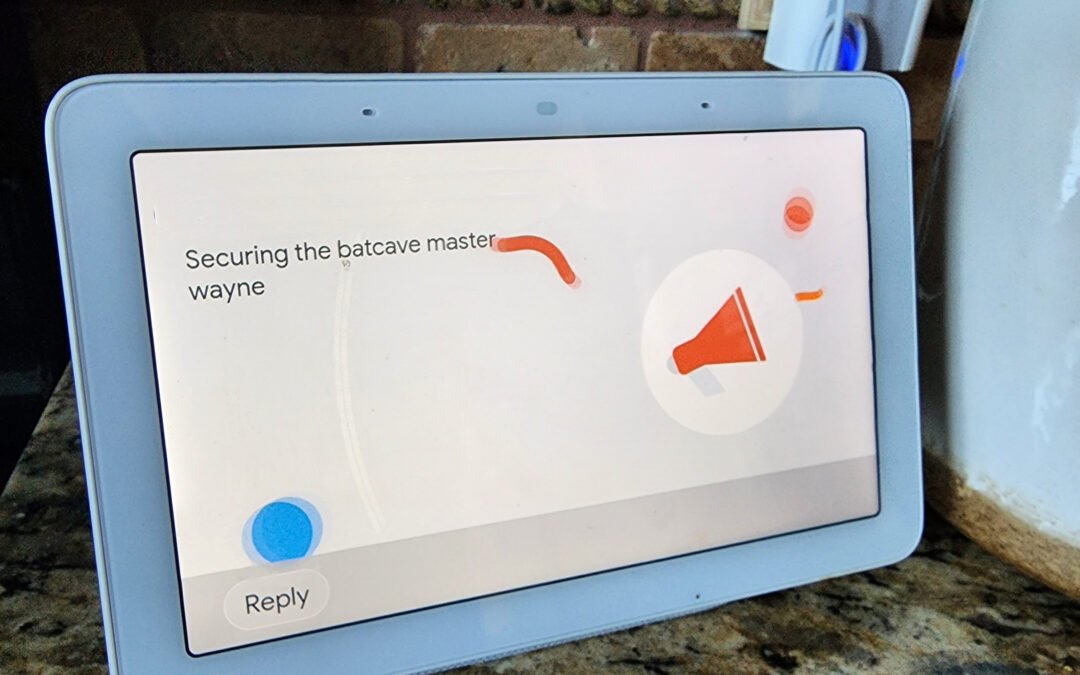
I’ve mentioned this one before. It aligns with this idea of mixing home automation devices in your life to really make tech work for you. I simply say, “Hey Google, Secure the Batcave.” Then all my doors lock (you need smart locks ____I personally have Kwikset SmartCode 916 deadbolt on all my exterior doors, including the door leading to the garage ), my Ring camera is armed, my smart floodlights are enabled, all the lights in my house are turned down, and the temperature is set at a cool 70 degrees by my smart thermostat.
I’m Going Downstairs
I have a personal den. It’s where I like to hangout. Sometimes I work there. Sometimes to get away. When I go downstairs, I can say, “Hey Google, I’m going downstairs.” My den lights get turned on to a specified brightness. I have a set of string LED lights that turn on. My TV turns on to my favorite streaming channel. And a portable fan turns on. I’ve thought about having an air freshener or air purified turn on, but don’t know yet if that’s taking this overboard 😉
I’m Getting Ready For Bed
This is one I didn’t think I’d use that much, but I’m finding that I love it more and more. I find I use it about 30 minutes to an hour before my head hits the pillow. I’ve also found new tweaks to add to this routine as well. I’ll say, “Hey Google, I’m Getting Ready For Bed.” From here, all the smart lights in my home drop 30% brightness. My bedroom fan turns on at low speed (I like fresh air when I sleep). And each of my kids gets a notification that they need to get ready for bed.
When we watch movies, this one is fun. I can say, “Hey Google, It’s movie time!” The lights in our living room get turned off, (if I had them) the smart blinds could close, the TV turns on to Netflix (or your favorite streaming channel), and we’re ready to watch our favorite flix.
Vacation Mode
This is another go-to favorite. When engaged, my Phillips Hue lights (color versions) will light up and flicker in my bedroom and living room with various colors during the night until about 1 am. From the outside it looks like someone is literally watching TV (I could have the TV turned on as well in this Routine as well, but I like the way the Phillips Hue lights work). Then at various times during the night different lights will come on and off making it look like someone is up and moving around. This is a clever Google Routine trick, but it’s effective.
Why I Love Google Routines
There are so many things to love about Google Routines! They are one of the most important factors in making your home truly smart. First of all, they make it super easy to manage your day-to-day tasks and make your tech work for you. With just a simple voice command or a click, you can create and edit your routines, schedule reminders, turn a light on or off, lock doors, enable your security cameras, set goals, and a slew of other amazing combinations. Plus, the Google Home interface is extremely user-friendly and the features are constantly updated. But perhaps my favorite thing about Routines is that they help me stay in control of the tech in my home and allow me to leverage what smart devices are really intended to do.
Yes, it’s cool to be able to turn lights on or off with a simple prompt. But to say, “Hey Google, I’m stressed,” followed by my lights being dimmed, a relaxing tune then being played from my smart speaker, followed by my doors being locked, and outside cameras turned on is the key to unlocking the “smart” in our tech.